Sunday, July 29, 2012

One fish, two fish, red fish, blue fish


The snorkeling was amazing!  We hired a boat to take us out to a coral reef to view the fish that live in this area of the Caribbean.  We went to the diving shop and were fitted for our gear and from there we boarded the boat; the boat was similar to the one in the national park, although a little more run down.

As I swam I saw lots of the same type of fish swimming near the surface where Beatriz (who was back in the boat) was throwing bread into the water.  As I got closer to the coral I could see a greater and greater variety of fish.  The smaller ones tended to stay closer to the coral while the bigger ones would swim towards the surface.
Later our boat driver took us to "natural pool" to swim.  The water was beautiful and the sand was white and soft.  There were several tourists boats with lots of people in the water with loud music and lots of drinking.  It was also the most people from the United States that we have seen the whole time we have been here.  It was almost jarring to hear so much English and to see so many people from our home country.  We saw again how much tourism can bring money and jobs to the DR, but also can have such an impact on the environment.  We asked our boat drive about working for the company he works for and how the pay was.  Like we have heard from most Dominicans who work in the tourism industry, the pay is just ok, but the work is enjoyable.  By the way, much of this economy is based on tipping and unofficial tour guides that you pay whatever you, the customer, feel is fair.


Thursday, July 26, 2012

Higuey

We spent the day in a town called Higuey. It is one of the DR's holy city where every January 21st they celebrate the patron saint of the DR, the Virgin of Altagracia, know for her ability to heal.  We found the central church of this town, Basilica de Nuestra Denora de la Merced very easily and parked in the near empty parking lot.  The church is a modern building and the stained glass, bronze doors, and leaves carved from wood are all very beautiful.
After looking at the church, we spent a few minutes in the parking lot where there were several vendors selling religious items and then we headed to one of the streets filled with markets.  It was another very hot day and Higuey is quite dusty.  The first store we went into had lots of clothes, shoes, and paintings all of which were  covered with dust.  Were we deterred?  No, of course not!  Both Beatriz and I bought paintings which the young men wrapped with newspaper and scotch tape.
Now we had some new friends and one of them was our guide for the rest of the afternoon.  He walked us to various stores, including a book store where we were able to buy some books and maps to take back to our school.  As a group, we attract attention where ever we go in the DR and today was no exception.  In Higuey, more that any other place, we had boys asking as for money as we walked around.  And like the other places we have been, we were constantly surrounded by motorcycles in Higuey.


Wednesday, July 25, 2012

Three teachers, a marine biologist, a boat captain, and the Caribbean Sea

We spent the day with a marine biologist, Rita Sellares, in one of the DR's national parks.  She works with FUNDAMAR, an organization dedicated to marine education and conservation.  We met her at the park office early in the morning,  picked up some cold drinks and ice, and we were on our way to the boat where we would spend the day touring one of the few places in the DR that is protected.  I have felt all along on this trip the sense that environmental issues and conversation feels like a luxury here, that food, water, and shelter are the basics and they have to come first.  Yet, I also feel that conservation, like education in this country, is deeply ignored and that the country could only benefit if more focus was placed on these issues.  Again, though, like with education, we saw the mix of poverty and people who are truly in need, mixed with a need for a great focus on environmental awareness.  These are very complicated issues and the three of us are struggling with how to reconcile all the needs of this small country.


our transportation for the day


The beauty of this area of the DR is hard to imagine.  The water is turquoise and crystal clear.  The sand, which is white and very fine grained, is mainly formed from a plant that calcifies and decomposes.  The main industry of this area is tourism.  You can imagine the double edged sword that this creates.  If it is done properly it can help, but when the tourism goes too far it destroys the natural environment.  Rita explained that they have "agreements" (nothing in writing) with several of the resorts here to tread carefully on the environment and to maintain this place as much as possible.  There are several tours that bring people out to the water to swim, scuba dive, and mostly party on the water.


We were in the boat for about an hour (with a stop for a swim!) to reach Isla Saona, the tiny island in the national park.  It is a mix of the Dominicans who have lived there for a very long time and some small tourist operations.  It was quiet, hot, and peaceful on the day we were there.  There are a couple of people dedicated to conservation  of sea turtles there.  There is a problem with people catching sea turtles and sea turtle eggs for profit, so there is an effort to gather the eggs and hold them til they hatch and then release them back to the water.


turtle eggs are kept in the coolers locked up in this area

We wanted to meet the man in charge of the sea turtles, but we arrived around 12:30 and he was sleeping, as is the custom here.

There are several small houses on the island, a clinic, and the school.  There is also a lot of trash.  Rita said it is difficult to deal with the trash.  If the people do collect it, then their way of getting rid of it is to burn it.  She also said there is very little water, electricity infrequently (there had been no power for 8 months), and tons of mosquitoes in the evenings.  A beautiful setting with many problems.  Also, one of the hottest places I have ever been.


The school on the island.  They only have classes until the 8th grade

Many donkeys and horses here


On our way back from the island the boat captain took us close to the shore so that we could see the rock, mostly made from limestone.  We could clearly see where erosion from the water had worn away the rocks.  We also was an area where there was a natural spring underneath the rocks creating a whole different ecosystem, one that was filled with little crabs running sideways.


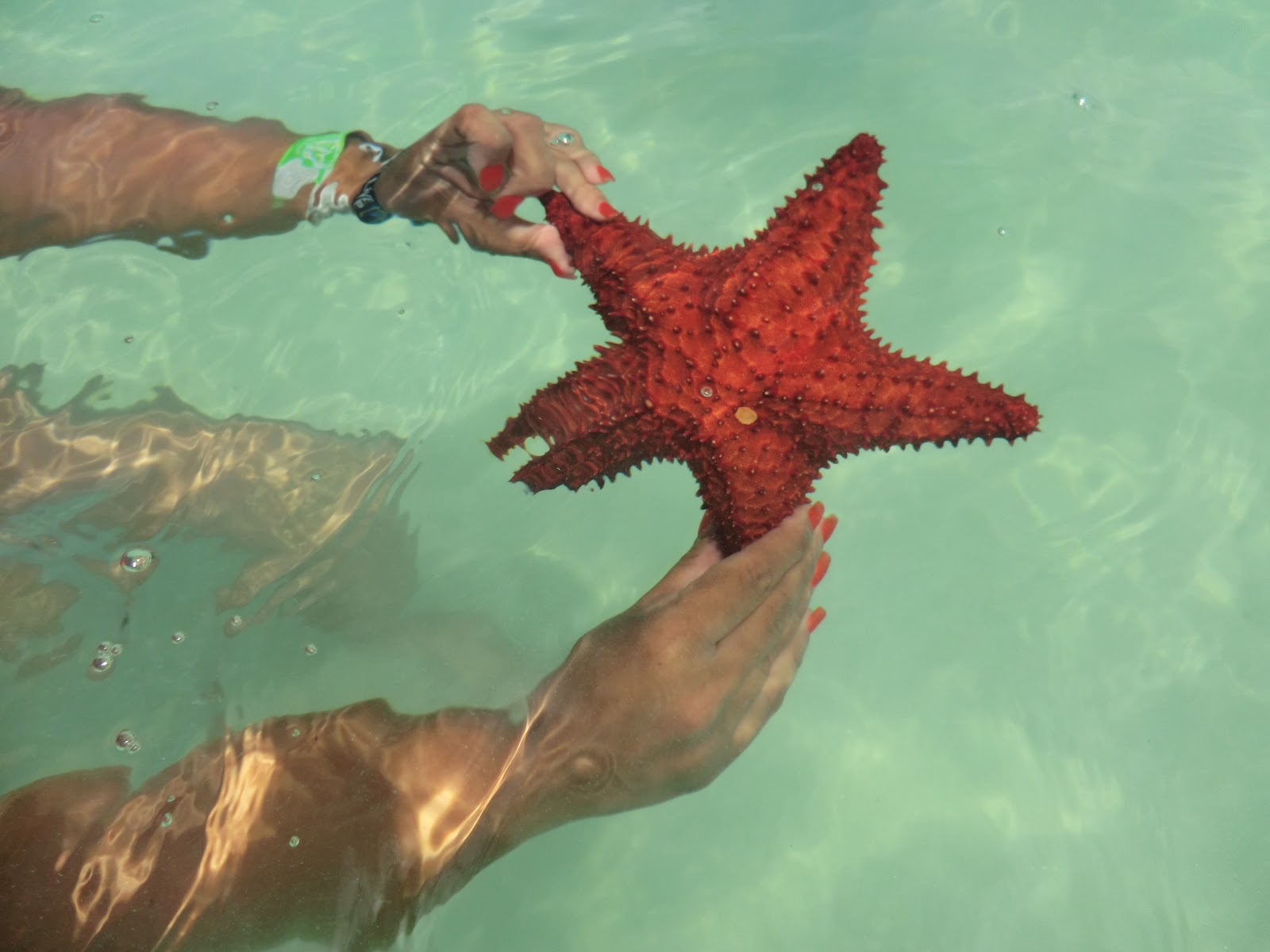
On our way back we also saw the sea stars we had seen in Salinas and some new birds.


A final interesting note.  The whales that live in Stellwagen Bank in Boston Harbor migrate here in the winter.  Another Boston/Dominican connection!  I know that this will offer a wealth of teaching opportunities for our students.

Everyday we learn more, gain understanding, and in the end, have more questions about this country. What an amazing experience this is.

Tuesday, July 24, 2012

Donde esta Citibank?

We seemed to be fully immersed in Dominican time.  Our plan was to leave Santo Domingo around 12:00.  We finally headed out of town around 3:00.  Part of the delay was the search for Citibank so that we could get money in pesos for the rest of the trip.  We headed to the Colonial Zone and asked several people where we might find Citibank; they all gave us directions which we followed.  When we got to the spot and there was no Citibank, we would ask the next person.  Finally, with great wisdom, Brendan yelled from the back of the van "just go to another bank!"  El hombre es muy intelligente!  We parked the car and there was the man who had helped us park the day before!  He walked us to an ATM machine and we were successful (after a few tries) in getting our pesos.
What time is it!?


We still had another issue to solve before getting on our way.  Our van had several seat belts that didn't work and one of the seats slid back and forth as we drove.  After arguing with the rental car company for the past few days with no results we decided to just get a new van from a different company.  This meant we had a two vans for a short time, which meant I had to drive through Santo Domingo. Brendan was my brave copilot.
Finally, we were on our way!  We headed out of town along with the pickup trucks on the highways carrying many people.
no seat belts and no seats
And after a couple of hours the landscape changed dramatically.  Now we saw open space and cattle and horses.  The noise of Santo Domingo was way behind us.  We discovered that the actual roads were not what was printed on our map or in the gps, but we found our way with occasional detours that would take us through small towns where boys would wash our windshield for a few pesos as we were stopped at a traffic light and the motorcycles buzzed around us.
Our gps-not really too helpful!  Cattle in the road.

Finally around 7:30 pm, and we don't seem to get anywhere before 7:30, we arrived at our hotel for this part of the trip.  We went to bed that night knowing that the next day we would go to the National Park in Bayahibe.


Sunday, July 22, 2012

Larimar

The Colonial Zone is the old city of Santo Domingo.  It is surrounded by tall walls and still has buildings from the 1500s.  We found a place to park, assisted by a man who has created a job for himself in helping people park, and then another man offered to give us a tour.  "How long and how much?" we asked.  "Maybe half an hour and the cost would be 800 pesos."  Sounded reasonable to us.  We spent the next two and a half hours with this man who seemed to know everything about this old city and also had taught himself three languages.  He even showed us the tomb of the man who started public education in the DR and the tomb of the woman who created schools for girls so that they could be teachers.


The gemstone Larimar, which is mined only in the DR.  The artist's ring is made of the stone.


Today we leave Santo Domingo and head to the eastern end of the island.  We have been told it is about a four hour drive.  I'm not sure what that actually converts to in time that I am familiar with.  I know enough now to just wait and see.


Salt mine and a beach


A swim at this beach was just what we needed after a long drive on Friday.  We have discovered that Bani is a large area in the Dominican Republic, not just one town.  There are several communities.  We covered a lot of km in Bani in the past two days.  We are holding sea stars.  They were found by a man who was collecting a variety of mollusks for his dinner.


One of the only of industries of Bani is salt.  This is the salt mine at the beach in Salinas.  The salt has a pink tone to it.


Friday, July 20, 2012

Bani y la playa de Salinas

Dominicans seem to have a skill for making the most use of any space that they have.  The motorcycles that fill the streets are packed with two, three, and sometimes four people.  We saw a man carrying a refrigerator on the back of his motorcycle.  A car that is designed for four or five people carries seven or eight.  The trucks are packed with produce:  thousands of bananas on the bed of one truck.  And when you get to a place where there are houses, they are right next to each other and right up against the road.


The goal of our trip to Bani today, and one of the goals of this whole trip to the DR, was to meet the grandmother of one of our families.  She raised the children while her daughter, their mother, went to the United States to earn enough money to bring the children there.  Seven years later the kids moved to the United States.  We only had to ask directions a few times today to find the home of this woman.  Once off the main road, we drove along a small street in Bani and asked a group of boys on the corner if they knew where she lived.  They pointed to an even smaller street and told us to turn there and we would find her.  This tiny street had several small houses, lots of wandering dogs, and children playing.  We asked another person and they pointed to a larger house, by far the largest and nicest house in the neighborhood,  at the end of the street.  This was the home of the grandmother who had raised several of our students.  Students that we all know and who are smart, and polite, and kind, and always eager to learn.  She came to the gate and welcomed us into her yard and her home.  Her husband was there and her sister and her sister's husband.  She showed us pictures of the kids:  Louisa, Luis, Rosa, another Luis, and yes, another boy named Luis who does not go to our school.   We sat in the area outside of the house and talked for a while.  Then they served us a lovely meal of chicken, rice, and salad.  We sat outside again afterwords and Beatriz said to the grandmother how difficult it must be to have not seen the kids for three years.  You could see the grief spread across her face.  I looked at my own daughter sitting across from me and couldn't imagine not seeing my own child for three years.